What Does Love Owe the Dead?
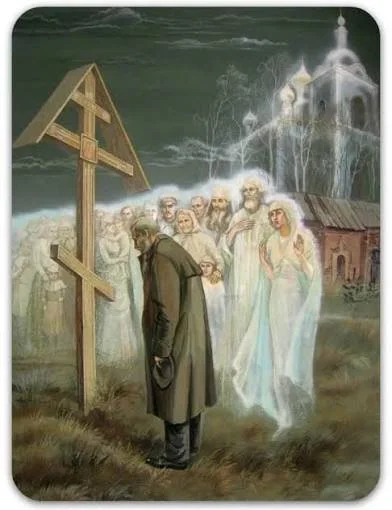
Every Christian knows the command to love thy neighbor. Christian teaching teaches that we do this by feeding the hungry, visiting the sick, forgiving our enemies, comforting those who mourn, and caring for the vulnerable, but after someone leaves this world, most Christians are unsure how to love that person. This brings up the inevitable question, “What does love owe the dead?
For much of Christian history, the answer was more obvious than it may seem now. Venerating the dead was a part of their private and corporate liturgical lives. The departed were buried with honor, remembered by name, prayed for, commemorated at the Eucharist, and visited on feast days. Their memory was preserved through liturgy, almsgiving, pilgrimage, and the tending of graves. To fail to care for the dead was to fail to love thy neighbor.1
Many modern Christians, however, have lost these practices. As a result of the Protestant Reformation, most Christians and even magicians who adhered strictly to certain grimoires that seemed more “Protestant” have inherited a much more restricted spiritual imagination. Later Christian grimoires reflect this shift: they remain within the tradition, but often emphasize God, angels, demons, divine names, and biblical authority while giving far less space to saints, purgatory, prayers for the dead, or the active communion of the departed. You also find this shift in folk magic as well. From this perspective, the dead are assumed to be “somewhere else,” beyond any meaningful relationship with the living. Prayer for the departed is often viewed with suspicion. Remembrance and memory of the dead is reduced to private expressions of grief. Any suggestion that the dead remain participants in the life of the Church risks being dismissed as superstition, ghost belief, heresy, or necromancy.2
Such assumptions, however, are historically narrower than many Christians realize. Early Christianity inherited an enchanted cosmos populated by angels, principalities, powers, saints, martyrs, holy places, blessings, relics, dreams, hostile spirits, and the righteous dead. Rather than abolishing this world, the Church sought to order it toward communion with God. Within this participatory vision, remembering the dead was an integral act that embodied charity, a continuation of love across the threshold of death.3
The Collapsing of the Christian Cosmos
Modern Protestant and Evangelical Christians often imagine the spiritual world as relatively simple. God reigns. Angels serve. Demons deceive. Human beings live, die, and go somewhere else. In such a framework, the dead easily disappear from Christian life. They may be mourned, but we can no longer interact with them, since they are seen as being disconnected, their fate decided, with nothing further we can do to help them. It is only hoped that they “believed” and “had faith” so that we might see them again one day.
This spiritual map, and the theology that supports it, would have been unrecognizable to ancient Jews and Christians of the first and later centuries. Their world was not empty space with religious ideas projected onto it. It was inhabited by various types of spiritual creatures. Their spiritual world was a place where the boundary between heaven and earth was not imagined as an impassable wall but as a threshold that could be crossed, returned from, or not even crossed at all.
Second Temple Jewish literature, which gives us great insight into the first-century New Testament context, already shows a world full of spiritual agency. The Dead Sea Scrolls speak of destructive spirits, ravaging angels, bastard spirits, Lilith, and demonic beings, yet these forces are not treated as independent rivals to God. They remain subject to God’s power and are understood within a broader divine order.4 Does this framework sound familiar? Pick up any popular grimoire, and you’ll find this same divine order.
The New Testament, as you can imagine, participates in this same inhabited universe. Paul speaks not only of Satan and demons but of principalities, powers, authorities, and the “elements of the world.” Chris Forbes argues that Paul’s language works on a continuum between abstractions, personified powers, literary personifications such as Sin and Death, and actual spiritual beings. Paul is not simply “demythologizing.” He is working creatively within both Jewish angelology and Hellenistic cosmology. Paul’s language of “principalities,” “powers,” “authorities,” and “elements of the world” does not fit neatly into the later categories of either literal demons or mere symbols. Forbes argues that Paul is working with a spectrum of spiritual and cosmic agency. On one end are abstract realities, such as “height” and “depth.” Near the middle are personified powers, such as principalities and powers. Alongside these are literary personifications like Sin, Death, and Law, which Paul speaks of almost as active rulers. On the other end are personal spiritual beings. Paul’s imagination can move across this spectrum without needing to sharply separate symbol, force, and spirit. Paul was reflecting a synthesis of the language of Second Temple Judaism and the Middle Platonism of his time. In that kind of world, a “power” could be more than an idea without being reduced to a later cartoon image of a demon.
So when Paul speaks of principalities and powers, he is describing an inhabited moral and cosmic order. These powers can be social, spiritual, cosmic, and personal all at once. That is exactly the kind of layered imagination modern readers often struggle to recover.5
This matters because modern readers often force ancient categories into rigid boxes. A “demon” must be an evil fallen angel. A “ghost” must be either impossible or a demonic deception. A “ritual” must be either religion or magic. But the ancient world did not always divide reality this way.
Rita Lucarelli’s work on Egyptian demonology shows that even the term “demon” is often a scholarly convention. Ancient Egyptian religion did not possess a single term equivalent to the later Christian idea of a demon as a purely evil spirit. Egyptian “demons” could be hostile, protective, ambiguous, local, or associated with the journey of the dead. Lucarelli notes that these beings were often intermediate and morally ambiguous, influencing daily life and the afterlife without replacing the official gods.6
Greek religion also complicates later assumptions. The Greek daimōn did not originally mean “evil spirit.” It could refer to an intermediary power, a guardian, a divine force, or a spiritual agency between gods and humans. In Greek and Hellenistic thought, daimones often occupied the space between gods and mortals, mediating divine activity, fate, protection, inspiration, and danger. The category was morally flexible before later Christian polemic increasingly identified demons with hostile powers.7
In summary, the worldview of the early Christians was much more akin to an enchanted or magickal worldview than the restricted spiritual imagination inherited by many modern Christians. The ancient cosmos was inhabited, participatory, and layered. Spirits, powers, angels, saints, and the dead could remain active within a world ultimately governed by God. In parts of Western Christianity, especially following the Protestant Reformation, many of these categories were narrowed, rearranged, or collapsed. This shift also changed how Christians understood their obligations toward the dead.
The Dead as Neighbors
If death does not remove a person from the communion and mercy of God, then it cannot completely remove that person from the responsibility of Christian love. The relationship changes, but the obligation of love does not simply disappear.
The dead can no longer be fed, clothed, or visited in precisely the same manner as the living, but they can still be remembered, honored, prayed for, buried with dignity, and included in acts of charity. Their graves can be tended. Their names can be preserved. Offerings may be made in their memory. Wrongs connected to their lives and deaths may still be acknowledged and, when possible, repaired for the good of the individual.
This is where Christian care for the dead begins in its recognition that the dead remain persons rather than discarded bodies, fading memories, or spiritual resources. Their value does not depend upon what knowledge, protection, or power they might provide to the living.
To call the dead our neighbors is to place an ethical limit upon our relationship with them. A neighbor may be asked for help, honored, remembered, or approached in love, but a neighbor should not be consumed. The dead should not be reduced to batteries of spiritual power, anonymous forces, or tools for the will of the practitioner.
Before asking what the dead can do for us, we must ask what love requires us to do for them.
Christian Care and Ancestor Veneration
Based on the above discussion, Christian care for the dead has more in common with ancestor veneration than with what we ordinarily imagine as necromancy. Both preserve a continuing relationship between the living and the departed through remembrance, prayer, ritual attention, offerings, the tending of graves, and obligations that do not end with death.
Necromancy, at least in its more coercive forms, approaches the dead primarily as sources of knowledge, power, or influence. Christian care approaches them as persons who remain worthy of love within the communion and mercy of God because they bear His Image.
This does not mean that the boundaries are always obvious from the outside. A candle may be lit, incense burned, a name spoken, a request made, or a gift offered in each setting. The difference is not necessarily found in the outward gesture. It is found in the theology of love and the relationship expressed through that gesture.
At an Orthodox funeral, the body may be censed, kissed, addressed, and treated with reverence. The body is not merely an empty shell that has become religiously irrelevant. The person remains an image of God, and the body remains worthy of honor because it participated in that person’s life, baptism, relationships, suffering, and future resurrection.
Christianity did not eliminate the ritual grammar of honoring the dead. It placed that grammar within a particular theology of God and personhood rooted in the image of God.
The shared ritual forms should also make Christians cautious about too quickly condemning the ancestral practices of other cultures as superstition or necromancy. Christians may explain candles, incense, prayers, offerings, sacred images, relics, and graves differently, but outward similarity cannot simply be ignored.
Ancestors Beyond the Church
Perhaps this is also one place where parts of Christianity have narrowed their own moral imagination. Christianity developed elaborate practices for venerating saints and martyrs, yet similar gestures directed toward non-Christian ancestors were often treated with suspicion, especially within missionary encounters. Christians could preserve relics, light candles, burn incense, make pilgrimages, and ask saints for their prayers, while ancestral rites practiced by other cultures were more readily classified as superstition, idolatry, or false worship.⁸
The Chinese Rites Controversy provides one of the clearest examples. Jesuit missionaries argued that Chinese ancestral rites could be understood as expressions of filial honor, remembrance, and social obligation rather than the worship of competing gods. Other Catholic missionaries rejected that distinction, and Rome eventually prohibited Chinese Christians from participating in the traditional rites. Protestant missionaries later reached similar conclusions. Many classified ancestor veneration as idolatry and prohibited Christian converts from using ancestral tablets, burning incense, bowing before the dead, or participating in other traditional rites.⁹
This created a strange division. Christians possessed a rich ritual language for honoring saints and martyrs, but converts from other cultures could be left without an acceptable way to honor their own non-Christian dead. The fear was not necessarily that every ancestor was an evil or hostile spirit. The greater fear was that addressing the dead, burning incense, presenting offerings, bowing, or preserving ancestral tablets crossed the boundary from remembrance into worship. Protestant missionaries were often especially suspicious of these outward ritual forms and sometimes struggled to distinguish between worship, veneration, commemoration, and filial respect.¹⁰ This response was more motivated by fear than a fear assessment of these cultural practices that should have remained.
Our ancestors remain our ancestors, whether they were Christian or not. Love does not require theological or creedal agreement. The dead should be honored because they are image bearers of God. This is the only qualification that each human being has.
Christian love should not be limited only to the dead whose theology we approve of. If Christ commands us to love our enemies while they are alive, it would be strange to conclude that death ends that responsibility (Matt. 5:44). This is an extreme example to make a point; the non-Christian dead are not our enemies, but the comparison is still true. If Christ says to love our enemies, then certainly we can find a place to love and honor all of the dead and the ancestors who have gone before us. The dead may have been unbelievers, members of other religions, morally complicated people, or people whose lives were marked by serious failures. None of this makes them cease to be human. None of it places them beyond the reach of love. They are all image bearers.
Conclusion: What Love Owes the Dead
Death changes our relationship with a person, but it does not erase them or end the responsibility of love. This is why Christians have prayed for the departed, remembered them at the Eucharist, given alms in their name, and cared for their bodies and graves.
If death fixes a person’s condition so absolutely that nothing can be received, healed, forgiven, or affected, then these practices would serve no purpose beyond comforting the living. Yet Christians historically acted as though they mattered to the dead and entrusted them more fully to the mercy of God.
This also means that Christian care for the dead has more in common with ancestor veneration than many Christians are willing to admit. The outward practices may look similar because both preserve the relationship and obligation across death. The important question is not simply what label we place on the practice, but what kind of relationship it creates. It is unfortunate that churches have required those who choose to follow Christ to abandon their ancestral practices out of fear.
Also, love requires that the dead should not be treated as sources of power or knowledge. They remain persons, whether they were Christian or not. Not approaching our ancestors in a coercive way is to honor the image of God that they bear.
Lastly,love does not require creedal agreement before it is enacted. This is the opposite of love and un-Christian.
So, what does love owe the dead? It owes them remembrance, prayer, actions for their benefit to ensure comfort and growth while in the intermediate state and in the world to come, and, most of all, the refusal to abandon or exploit them.
Death changes the form of love, but it does not end it. Love owes the dead.
Footnotes:
Peter Brown, The Cult of the Saints: Its Rise and Function in Latin Christianity (Chicago: University of Chicago Press, 1981), 1–22; Éric Rebillard, The Care of the Dead in Late Antiquity (Ithaca, NY: Cornell University Press, 2009), 1–18; Augustine, Confessions, 9.11–13, in The Confessions, trans. Maria Boulding (Hyde Park, NY: New City Press, 1997), 246–51.
Peter Marshall, Beliefs and the Dead in Reformation England (Oxford: Oxford University Press, 2002), 1–12; Bruce Gordon and Peter Marshall, eds., The Place of the Dead: Death and Remembrance in Late Medieval and Early Modern Europe (Cambridge: Cambridge University Press, 2000), 1–16; Carlos M. N. Eire, Reformations: The Early Modern World, 1450–1650 (New Haven, CT: Yale University Press, 2016), 627–28.
Chris Forbes, “Pauline Demonology and/or Cosmology? Principalities, Powers and the Elements of the World in Their Hellenistic Context,” Journal for the Study of the New Testament 85 (2002): 51–73; Peter Brown, The Cult of the Saints: Its Rise and Function in Latin Christianity (Chicago: University of Chicago Press, 1981), 1–22; Michael J. Morris, Warding Off Evil: Apotropaic Tradition in the Dead Sea Scrolls and Synoptic Gospels (Tübingen: Mohr Siebeck, 2017); Ida Fröhlich, “Theology and Demonology in Qumran Texts,” Henoch 32, no. 1 (2010): 101–30.
Ida Fröhlich, “Theology and Demonology in Qumran Texts,” Henoch 32, no. 1 (2010): 101–4.
Chris Forbes, “Pauline Demonology and/or Cosmology? Principalities, Powers and the Elements of the World in Their Hellenistic Context,” Journal for the Study of the New Testament 85 (2002): 51–53, 58–60.
Rita Lucarelli, “Demonology during the Late Pharaonic and Greco-Roman Periods in Egypt,” Journal of Ancient Near Eastern Religions 11 (2011): 109–15.
Dale B. Martin, Inventing Superstition: From the Hippocratics to the Christians (Cambridge, MA: Harvard University Press, 2004), 136–68; Everett Ferguson, Demonology of the Early Christian World (Lewiston, NY: Edwin Mellen Press, 1984), 33–59.
Peter Brown, The Cult of the Saints: Its Rise and Function in Latin Christianity (Chicago: University of Chicago Press, 1981), 1–22; Paul Rule, “The Chinese Rites Controversy: Confucian and Christian Views on the Afterlife,” Studies in Church History 45 (2009): 280–300.
Rule, “Chinese Rites Controversy,” 280–300; James Thayer Addison, “Chinese Ancestor-Worship and Protestant Christianity,” The Journal of Religion 5, no. 2 (1925): 140–49, especially 143–49.
Addison, “Chinese Ancestor-Worship,” 147–49.
Bibliography
Addison, James Thayer. “Chinese Ancestor-Worship and Protestant Christianity.” The Journal of Religion 5, no. 2 (1925): 140–49.
Augustine. The Confessions. Translated by Maria Boulding. Hyde Park, NY: New City Press, 1997.
Brown, Peter. The Cult of the Saints: Its Rise and Function in Latin Christianity. Chicago: University of Chicago Press, 1981.
Eire, Carlos M. N. Reformations: The Early Modern World, 1450–1650. New Haven, CT: Yale University Press, 2016.
Forbes, Chris. “Pauline Demonology and/or Cosmology? Principalities, Powers and the Elements of the World in Their Hellenistic Context.” Journal for the Study of the New Testament 85 (2002): 51–73.
Fröhlich, Ida. “Theology and Demonology in Qumran Texts.” Henoch 32, no. 1 (2010): 101–30.
Gasparini, Valentino. “Isis and Osiris: Demonology vs. Henotheism?” Numen 58 (2011): 697–728.
Gordon, Bruce, and Peter Marshall, eds. The Place of the Dead: Death and Remembrance in Late Medieval and Early Modern Europe. Cambridge: Cambridge University Press, 2000.
Johnson, Maxwell E. Praying and Believing in Early Christianity: The Interplay between Christian Worship and Doctrine. Collegeville, MN: Liturgical Press, 2013.Lavater, Ludwig. Of Ghostes and Spirites Walking by Nyght. Translated by R. H. London, 1572.
Lucarelli, Rita. “Demonology during the Late Pharaonic and Greco-Roman Periods in Egypt.” Journal of Ancient Near Eastern Religions 11 (2011): 109–25.
Marshall, Peter. Beliefs and the Dead in Reformation England. Oxford: Oxford University Press, 2002.
Martin, Dale B. Inventing Superstition: From the Hippocratics to the Christians. Cambridge, MA: Harvard University Press, 2004.
Morris, Michael J. Warding Off Evil: Apotropaic Tradition in the Dead Sea Scrolls and Synoptic Gospels. Tübingen: Mohr Siebeck, 2017.
Ogden, Daniel. Magic, Witchcraft, and Ghosts in the Greek and Roman Worlds: A Sourcebook. 2nd ed. Oxford: Oxford University Press, 2009.
Rebillard, Éric. The Care of the Dead in Late Antiquity. Ithaca, NY: Cornell University Press, 2009.
Rule, Paul. “The Chinese Rites Controversy: Confucian and Christian Views on the Afterlife.” Studies in Church History 45 (2009): 280–300.
