Binding Words: A Practitioner’s Review
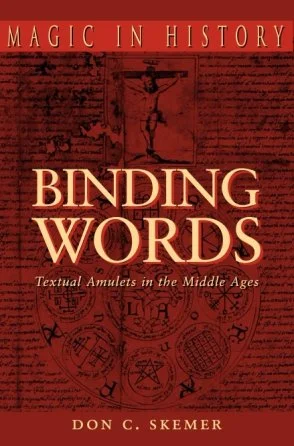
I recently finished Don C. Skemer’s Binding Words: Textual Amulets in the Middle Ages, published by Penn State University Press as part of the Magic in History series. Rather than attempting a chapter-by-chapter summary, I want to offer a practitioner-oriented review of several ideas that I found especially relevant to the making and use of amulets and talismans.
What interested me most was Skemer’s description of textual amulets as interactive ritual objects. They were not always passive items worn without being read, viewed, touched, or otherwise engaged. They could prompt prayers, gestures, visualization, narrative reenactment, and other forms of continued participation.
These practices immediately brought to mind the pentacles of the Key of Solomon. Skemer’s research provides a useful historical framework for thinking about how pentacles may have been used after their construction and consecration, particularly when the surviving grimoire gives only limited instructions.
A conversation with another practitioner further confirmed that some of the possibilities suggested by Skemer are congruent with established Solomonic practice. She noted, for example, that practitioners instruct the recipients of pentacles to recite the scriptural verse found in the versicle to activate and prolong their ongoing effectiveness. Skemer does not introduce an entirely new way of working with these objects; rather, his research helps place practices already used by practitioners within the broader medieval culture.
This is what makes Binding Words especially valuable to me. It offers historical evidence and a clearer vocabulary for understanding practices that may already feel natural within a Solomonic context. Reciting a pentacle’s verse, holding it during prayer, contemplating its image, or otherwise interacting with it are not modern additions. They are consistent with a medieval ritual environment and how sacred objects were used.
Textual Amulets and Talismans
Before examining those techniques, it is important to clarify some terminology.
Textual amulets were the Western successors of the papyrus amulets used in Roman and Byzantine Egypt. Although the word amulet has undergone etymological changes and shifts in use, it can still be primarily defined as an object intended to protect its wearer against a host of afflictions. Historically, this could include protection against evil spirits, visible or invisible enemies, personal misfortune, sudden death, plague, illness, and pain in particular parts of the body.
In the contemporary occult world, it is popular to say that an amulet “pushes things away,” while a talisman “draws things toward you.” That is not the academic distinction Skemer uses.
In Binding Words, talismans are generally more image- or symbol-oriented in terms of the source of their efficacy, whereas the particular genre of amulet studied by Skemer depends upon written words. A talisman might therefore resemble what many of us think of as a Solomonic pentacle. It may include writing, but text is not necessarily the sole source of its power. A textual amulet, by contrast, requires text.
This distinction is important, but it was never absolute. A textual amulet could also be talismanic, and a talisman could perform an amuletic or protective function. I think we see this overlap especially clearly in the pentacles of the Key of Solomon. They combine figures, divine names, scriptural passages, characters, seals, and protective or operative purposes.
Historical Context
In the early medieval period, many textual amulets were produced by clerics or people working within clerical environments. They had access to Latin literacy, writing materials, liturgical books, biblical texts, and other sources from which amuletic material could be drawn.
These early medieval amulets were often Christian in content. They included scriptural passages, prayers, divine names, crosses, saints’ names, liturgical phrases, and narratives about Christ or biblical figures. From the twelfth and thirteenth centuries onward, this situation began to change with the translation and circulation of Arabic, Jewish, Greek, and pseudo-Solomonic materials, which introduced additional forms of learned magic into Latin Europe via the Iberian Peninsula, southern Italy, and the Crusader states.
Also during this period, literacy was expanding beyond the clergy. This increased the number of people who could potentially copy, adapt, commission, or use textual amulets and talismans. This is, as I hypothesize, also a contributing reason for the blending of the two traditions that occurred during this period.
By the time we reach the surviving manuscript traditions associated with the Key of Solomon, we are looking at a world in which textual amulets and image-based talismans could overlap in both form and function. That does not mean every technique Skemer describes was necessarily used with every Solomonic pentacle, but it does mean that the two traditions participated in a broader ritual culture in which words, images, gestures, numbers, materials, and spoken prayers were frequently combined.
Grimoires as Auxiliary Texts
One of the most useful implications of Skemer’s work is that it makes strict grimoire purism difficult to maintain.
Surviving grimoires were not always complete handbooks. They frequently assumed that the reader already possessed certain prayers, practical skills, ritual habits, or supplementary knowledge. The texts might provide ritually essential information without explaining every procedural detail.
The Key of Solomon, for example, refers to the Ring and Seal of Solomon as sources of ritual authority but does not consistently provide complete instructions for their construction. Other prayers, tools, and procedures vary between manuscript traditions or appear in one version while being absent from another.
If the surviving texts assume access to practices, materials, or knowledge they do not fully record, then some degree of reconstruction is unavoidable. That does not mean adding whatever we please; however, it does mean looking at the broader ritual culture surrounding the grimoires for historically plausible practices that may clarify how ritual objects were made, handled, maintained, and used.
Skemer is valuable for this purpose because he documents techniques that were widespread in the medieval culture surrounding the development of later Western ritual magic. Even when those techniques are not explicitly described in a Solomonic manuscript, they help us understand what a medieval reader might have regarded as ordinary or self-evident.
Textual Prompts and Spoken Prayer
One of the most applicable techniques Skemer describes is the use of textual prompts.
A textual amulet might include only the opening words of a well-known prayer or biblical passage. These opening words served as an incipit, prompting the wearer to recite the entire prayer from memory. A Pater Noster could indicate the full Lord’s Prayer. Other common examples included the Ave Maria, the Credo in unum Deum, Miserere mei Deus from Psalm 51, or Dominus regit me from Psalm 23.
This was not limited to magical texts. Liturgical and devotional manuscripts could simply instruct the reader to say the Pater Noster, the seven penitential psalms, or another familiar prayer. It was assumed that the reader already knew the complete text.
This provides an important context for the scriptural versicles written around many of the Solomonic pentacles. It is possible that the written verse was valued as sacred text in its own right while also functioning as a prompt for oral recitation.
Reciting the verse surrounding a pentacle is already an established practice for some people working within the Solomonic tradition. Skemer’s research does not invent that practice, but it helps demonstrate that it is compatible with medieval habits of reading and ritual performance, and maybe reciting entire psalms or passages could contribute to the continued efficacy of a pentacle.
It is possible that the opening verse may even have recalled a complete psalm that the practitioner or wearer was expected to know and recite according to certain rubrics.
Crosses and Ritual Gestures
A second technique is the use of symbols as ritual prompts.
Skemer notes that handwritten crosses and accompanying punctuation could serve as visual shorthand, directing the faithful to perform an appropriate ritual gesture. The number of crosses might indicate how many times the wearer was expected to cross themselves or bless the object.
This is another reminder that a symbol on an amulet did not necessarily function only as a static source of power. It could also tell the user what to do.
Applied cautiously to Solomonic pentacles, crosses may have functioned as sacred signs within the design while also prompting physical gestures during consecration, prayer, or later use. We should not assume that every cross indicates an unrecorded gesture, but Skemer shows that medieval readers were accustomed to interpreting such marks performatively.
The text could prompt speech, and the cross could prompt movement, adding to the overall ritual choreography of amulets and talismans.
Number and Repetition
Skemer also emphasizes the importance of number. Christian numerology was widespread in the medieval world, and numbers could shape both the meaning of an object and the way it was used.
Three could signify the Holy Trinity. Four might refer to the Gospels, the cardinal virtues, or the letters of the Tetragrammaton. Five could evoke the wounds of Christ or the books of Moses. Seven might refer to the gifts of the Holy Spirit or the petitions of the Lord’s Prayer. Eight could signify the everlasting day of the Resurrection.
These associations could affect the number of prayers, crosses, ritual gestures, or folds used with an amulet. A practitioner might instruct someone to recite a prayer a certain number of times each day, much as a priest might assign a number of prayers following confession.
Astrology contributed another layer to this medieval understanding of number, though this is not emphasized by the author in this particular volume.
Interactive Amulets
All these practices culminate in a picture of amulet use that involves active participation.
Skemer notes that they could be “read, performed, displayed, visualized, and used interactively.” Their efficacy could involve continued acts of speech, sight, memory, gesture, and touch.
This is one of the most useful insights in the book in my opinion.
It challenges the assumption that an amulet or talisman was simply manufactured, consecrated, and then carried as a self-contained magical battery. Some objects may certainly have been used passively, but others depended upon a continuing relationship between the object and its wearer.
The amulet could remind the wearer to pray. Its crosses could prompt gestures. Its numbers could regulate repetition. Its words could be spoken aloud. Its image could be contemplated or recalled from memory.
Historiolae and Sacred Narrative
Another important technique was the use of narrative charms or historiolae.
These were brief stories, anecdotes, or scriptural references in which a sacred or legendary figure experienced a condition that foreshadowed the present problem. The narrative then recalled how the earlier crisis was overcome, thereby allowing that past resolution to serve as the model for the desired result.
Within a magico-religious context, the historiola reduced the distance between past and present. The practitioner was not simply remembering a miracle. The ritual sought to make the power of that miracle present again.
A biblical event could therefore function as a sacred precedent. What God had done before established the pattern for what the practitioner hoped God would do now.
This technique is especially relevant to one of the pentacles of the Moon.
Visualization, Memory, and Contemplation
Skemer also discusses visualization and contemplation as ways of activating or continuing an amulet’s benefits.
The medieval reception of Aristotle provided an intellectual framework for understanding how sight and hearing affected the interior person. Images, words, and knowledge could enter through the senses and become impressed upon the heart or memory, much like a seal pressed into warm wax.
Once a talismanic image had been impressed upon memory, its influence did not necessarily depend upon the wearer continually looking at it. If the token remained on the body or could be grasped in the hand, the wearer could recall and visualize its image internally.
The circulation of the Picatrix and other handbooks of learned magic contributed to a broader intellectual culture in which images were treated as operative. An image could be constructed, viewed, remembered, and reproduced within the imagination.
The physical object and the remembered image could reinforce one another. Even when an amulet was folded, concealed, or worn beneath clothing, touching it could recall its form and meaning to the mind, thereby increasing its magical effectiveness.
Perhaps this is applicable to the use of Solomonic pentacles. Could the efficacy be increased if time were spent contemplating the pentacles and engaging with them more actively rather than just passively wearing them?
Applying These Ideas to the Key of Solomon
To explore these techniques and their possible relationship to the Solomonic pentacles, let us begin with the Sixth Pentacle of the Moon.
Like many pentacles in the Key of Solomon, it is surrounded by a scriptural versicle. In this case, the verse comes from Genesis 7:11–12 and refers to the opening of the fountains of the deep and the rain that covered the earth during the Flood. As one might expect, the pentacle is used to produce rain.
What is especially interesting is that the pentacle is supposed to be submerged in water as part of its use.
I also suspect that the figure at its center may function as a type of compass rose representing the whole earth submerged beneath the waters of the Flood (the biblical world viewed the land as a floating disk on water). This interpretation remains speculative, but if it is correct, the pentacle combines an image of the world, a scriptural account of universal inundation, and a physical action that reproduces the narrative on a smaller ritual scale.
This makes the Sixth Pentacle of the Moon a possible example of both ritual choreography and the use of a historiola. The practitioner does not just refer to the biblical Flood but ritually reenacts it by placing the pentacle beneath water while using a verse that recalls the original event, and maybe, perhaps, the individual saw the one verse as a prompt to read the entire Genesis narrative.
The action symbolically reduces the distance between the biblical past and the practitioner’s present need. The former miracle becomes the pattern for the desired result. Just as the narrative charms described by Skemer invoked a sacred event in order to reproduce its benefits, this pentacle may use the Flood narrative as a model for producing rain.
It also preserves a description of post-conjuration use. The pentacle was not simply created, consecrated, and then worn or stored. It was physically handled and deployed as part of a continuing ritual process.
Several other pentacles preserve similarly explicit instructions.
The Sixth Pentacle of Jupiter is to be viewed devoutly each day while its versicle is recited. The Seventh Pentacle of Jupiter is likewise to be contemplated daily during the recitation of Psalm 112.
These examples explicitly coordinate the physical image with visual attention, spoken scripture, and daily repetition. They provide direct evidence that at least some scriptural versicles were not included merely as written sources of power. They were also intended for oral performance.
This demonstrates that Skemer’s research intersects with contemporary practitioner experience. Some practitioners already do this as an ordinary part of their work. Skemer helps place that practice within a much older culture in which written texts commonly prompted memorized prayers and repeated ritual actions.
Taken together, these examples reveal several modes of post-conjuration use. A pentacle might be submerged in water, looked upon daily, held during prayer, displayed at a particular moment, or used as a prompt for the recitation of an accompanying verse or complete psalm.
Its efficacy was connected not only to its construction and consecration but also to the practitioner’s continued participation through sight, speech, memory, gesture, and material action.
Final Thoughts
Binding Words is not a book about the Key of Solomon, nor is it a practical manual for contemporary talismanic magic. Its importance for practitioners lies in the ritual world it reconstructs.
Skemer shows that medieval amulets were embedded within habits of prayer, memory, reading, gesture, sacred narrative, visualization, and material interaction. These objects could be worn, but they could also be read, touched, displayed, spoken over, contemplated, unfolded, and ritually enacted.
This broader context helps explain why grimoires do not always record every detail of an object’s continued use. Some practices may have been sufficiently familiar that they did not require extensive explanation. Others may have varied according to local custom, clerical instruction, manuscript tradition, or the habits of an individual practitioner.
The book therefore does not give us permission to add anything we please to the Key of Solomon. What it gives us is a historically informed way of asking better questions.
How was the pentacle handled after its consecration? Was its verse spoken aloud? Was the complete psalm recited? Was the image contemplated or recalled from memory? Did the user perform the sacred narrative physically, as in the immersion of the lunar pentacle? Were crosses and numbers understood as prompts for gestures and repetition?
In some cases, the Key itself answers these questions. In others, the practices documented by Skemer offer plausible historical context. Perhaps most importantly, that context is congruent with what at least some Solomonic practitioners are already doing.
The value of Binding Words is therefore not that it reveals a completely forgotten secret. Its value is that it demonstrates how deeply interactive medieval amuletic practice could be and gives historical depth to the idea that a pentacle is not merely an object one possesses, but uses. I hope this article inspires practitioners and pentacle recipients to be more experimental with post-conjuration use of pentacles.
